Last Updated: 21 September 2026
What is Mounjaro?
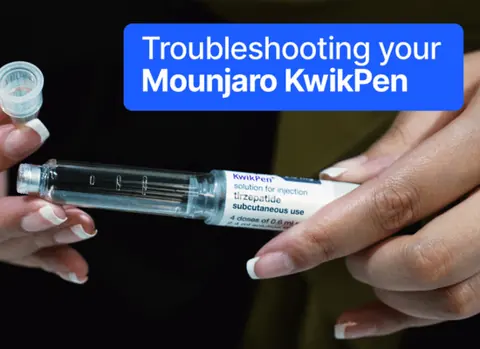
Mounjaro (tirzepatide) is a once-weekly injection made by Eli Lilly. The UK licence for Mounjaro covers use in both weight management and type 2 diabetes.
Tirzepatide copies two gut hormones, GLP-1 and GIP. Every other weight loss medicine that copies gut hormones works on GLP-1 alone.
Your body releases both GLP-1 and GIP after you eat. The hormones reach the part of your brain that controls hunger. The result is that you feel full sooner and stay full for longer. Digestion slows too, and that keeps your blood sugar levels steadier.
Prescribers can offer Mounjaro to adults with a BMI of 30 or above. The threshold drops to 27 if you also have a weight-related condition, such as high blood pressure, sleep apnoea or type 2 diabetes.
Understanding Wegovy
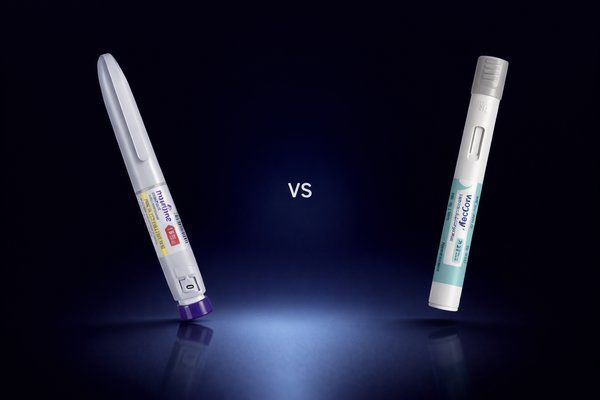
Wegovy (semaglutide) is another once-weekly weight loss injection, made by Novo Nordisk. Semaglutide only mimics GLP-1 and is known as a GLP-1 receptor agonist. As with Mounjaro, its action leads to your appetite dropping. Food sits in your stomach longer, so you feel less hungry, and your portion sizes shrink.
Like Mounjaro, Wegovy is licensed for weight loss in adults with obesity or overweight with a related health condition. But Wegovy carries more than one licence that Mounjaro does not. UK regulators, the MHRA, approved it to lower the risk of heart attack, stroke or death from heart disease. Eligibility runs to adults who already have heart disease and a BMI of 27 or above.
Wegovy has no UK licence for type 2 diabetes. The NHS lists two other semaglutide brands, Ozempic and Rybelsus, for that purpose instead.
How effective are Mounjaro and Wegovy?
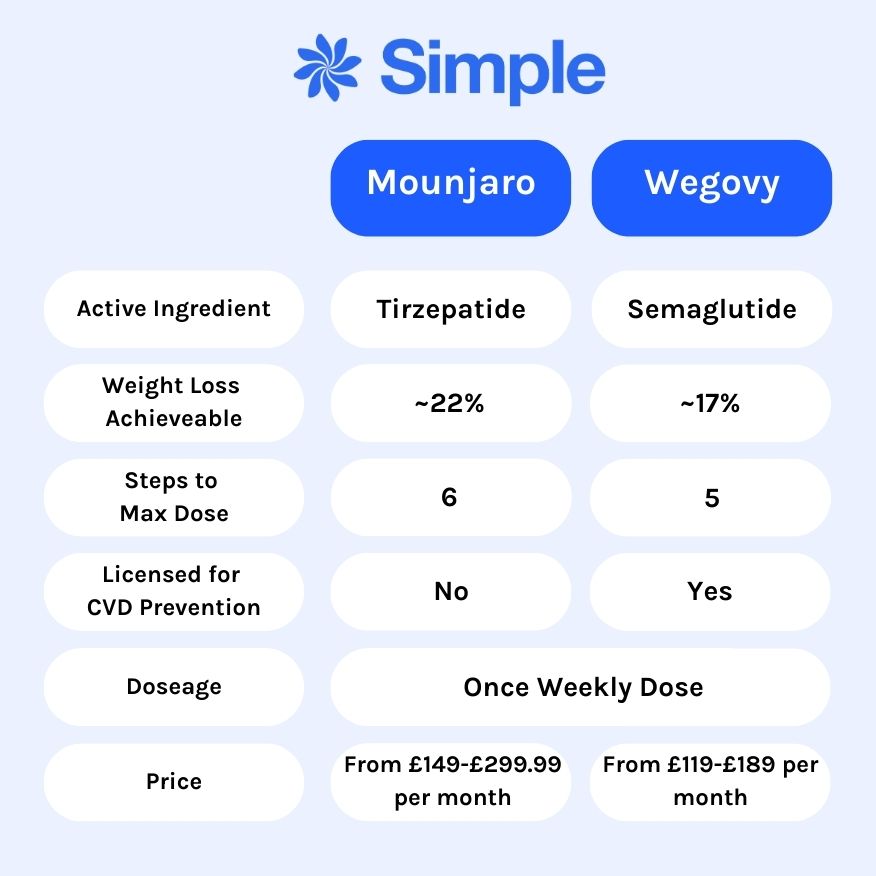
Mounjaro produced greater weight loss than Wegovy in the one trial that directly compared them. The SURMOUNT-5 trial placed 751 adults with obesity on one of the two weekly injections for 72 weeks.
| Mounjaro (tirzepatide) | Wegovy (semaglutide) | |
| Average weight loss | 20.2% | 13.7% |
| Average weight lost, from a starting weight of 113 kg | 22.8 kg | 15.0 kg |
| Average waist reduction | 18.4 cm | 13.0 cm |
| Average drop in BMI | 8.0 points | 5.3 points |
| Lost 10% or more of their body weight | 81.6% | 60.5% |
| Lost 25% or more of their body weight | 31.6% | 16.1% |

Separate trials tell you less than a direct comparison does, but both medicines have been tested against placebo. Placebo means an inactive injection given for comparison. In SURMOUNT-1, adults on the top 15mg dose of tirzepatide lost 20.9% of their weight over 72 weeks, against 3.1% on placebo. In the STEP 1 trial, adults on semaglutide 2.4mg lost 14.9% across 68 weeks, against 2.4% on placebo.
The two trials enrolled different people over different lengths of time, so figures are not strictly comparable. But they do point the same way as the head-to-head SURMOUNT-5 result.
Which will work better for me?
The trial result tells you which medicine produced more weight loss on average, across a large group of people. It does not tell you which medicine suits you as an individual.
Both medicines are effective for weight loss. You take each weight loss injection alongside dietary changes and an increase in physical activity, not instead of them.
The deciding factors for which option may suit you better include:
- existing heart disease
- type 2 diabetes
- the contraceptive pill
- tolerance of the early doses
- your starting weight
- what you can access or afford.
Your medical history often points to the right answer before the trial data does. You should always provide a complete and accurate medical history, including details of any medicines you are taking. This allows your prescriber to make the safest and most appropriate decision for you. Existing heart disease supports the use of Wegovy. In its SELECT trial, Wegovy cut the risk of heart attack, stroke or death from heart disease by about a fifth. Type 2 diabetes makes the case for Mounjaro. Its licence covers diabetes treatment as well as weight management. Although these medicines have different licensed indications, we currently prescribe them only for weight management.
Starting weight changes what the gap between Mounjaro and Wegovy means in practice. For someone at 85kg, the difference between 20.2% and 13.7% works out at about 5.5kg. At a starting weight of 150kg, that is closer to 10kg. The more you have to lose, the more that difference is worth thinking about.
Two people on the same weight loss medication, at the same dose, can lose markedly different amounts. Men lost less than women on both treatments in SURMOUNT-5. That trial enrolled more men than earlier obesity trials did, which its authors suggest is why its averages sit lower.
Also, another thing to consider is that Mounjaro can reduce how well the contraceptive pill works. NHS England advises a second method for four weeks after you start and after every dose increase. Semaglutide does not carry the same contraceptive warning.
Does one have fewer side effects than the other?
Both Mounjaro and Wegovy carry a similar side effect profile. Digestive symptoms lead the list for each: nausea, diarrhoea, vomiting and constipation.
| Side effect | Mounjaro (5 mg to 15 mg) | Wegovy (2.4 mg) |
| Nausea | 24.6% to 33.3% (placebo 9.5%) | 44.2% (placebo 17.4%) |
| Diarrhoea | 18.7% to 23.0% (placebo 7.3%) | 31.5% (placebo 15.9%) |
| Vomiting | 8.3% to 12.2% (placebo 1.7%) | 24.8% (placebo 6.6%) |
| Constipation | 11.7% to 17.1% (placebo 5.8%) | 23.4% (placebo 9.5%) |
| Indigestion | 8.9% to 11.3% (placebo 4.2%) | 10.3% (placebo 3.5%) |
| Abdominal pain | 4.9% to 5.3% (placebo 3.3%) | 10.0% (placebo 5.5%) |
Symptoms tend to cluster as you increase your dose and then usually settle. Among people taking Wegovy, nausea lasted on average around 8 days, vomiting 2 days and diarrhoea 3 days. Constipation ran longer, at an average of 47 days.
One rare eye condition has been linked to semaglutide but not tirzepatide. It affects the optic nerve and can cause sudden vision loss, usually in one eye. Cases are rare, and the Wegovy prescribing information reflects that.
How well you tolerate each dose during dose escalation helps your prescriber decide whether to increase your dose and which maintenance dose is right for you. Side effects sometimes stop people from stepping up to the higher doses.
What are the dosage differences between Wegovy and Mounjaro?
Both are weekly injections that build up in steps, and the two schedules run to different lengths, as per the product information leaflet. Building up slowly gives your body time to adjust and reduces risks of side effects like nausea, vomiting and diarrhoea in the early weeks.
| Mounjaro (tirzepatide) | Wegovy (semaglutide) | |
| Starting dose | 2.5mg once weekly | 0.25mg once weekly |
| Minimum time per step | 4 weeks | 4 weeks |
| First licensed maintenance dose reached (if tolerated) | After 4 weeks, at 5mg | After 16 weeks, at 2.4mg |
| Recommended maintenance doses | 5mg, 10mg or 15mg | 2.4mg, or 7.2mg if needed and BMI is above 30 |
| Highest licensed dose | 15mg once weekly | 7.2mg once weekly |
| Missed dose window | Within 4 days | Within 5 days |

Your maintenance dose does not have to be the highest one available. Mounjaro also comes in 7.5mg and 12.5mg pens, which sit between the recommended maintenance doses. Some people settle on one of those long term. If you are losing weight steadily and tolerating your current dose well, staying with it is a reasonable option.
You use the same injection technique for both medicines. They can be administered subcutaneously into your stomach, thigh or upper arm. Both medicines use a pre-filled pen, and you can inject at any time of day, with or without food. Change where you inject each week to avoid skin irritation.
Both product licences allow you to move your injection day if you choose. You must leave at least three days between doses. However, the missed dose rules differ slightly between the two. You have four days to take a late Mounjaro dose and five days for Wegovy. After that, skip it and go back to your usual day. Doubling up puts two doses too close together, which may bring on side effects.
What else should I consider when choosing between Mounjaro and Wegovy?
Wegovy and Mounjaro are each licensed for more than weight management. Their extra uses do not overlap.
Wegovy’s heart approval only covers adults who already have heart disease. It came from SELECT, a trial of 17,604 adults in exactly that position. The licence does not cover anyone outside that group.
The two medicines also differ on age restrictions. Wegovy covers weight management from the age of 12. Mounjaro is licensed for weight management in adults only. However, Mounjaro does cover type 2 diabetes from the age of 10.
One further Wegovy licence covers a form of fatty liver disease. It applies to adults whose liver has moderate to advanced scarring but has not reached cirrhosis.
How do accessibility and cost compare for Mounjaro versus Wegovy?
The NHS route and the private route apply to both medicines. Mounjaro became substantially more expensive privately during 2025. Eli Lilly raised its published UK price from 1 September 2025. Prices moved from roughly £92 to £122 a month, up to between £133 and £330, depending on the dose and provider.
The 2025 price rise did not change what you pay for an NHS prescription. Each clinic or pharmacy sets its own private prices, so what you pay varies between providers. You can get both through an online pharmacy or in person, with the same prescribing checks either way.
The National Institute for Health and Care Excellence (NICE) decides which treatments the NHS funds. It sets tighter rules for both injections than their licences do. NICE recommends tirzepatide on the NHS for adults with a BMI of at least 35 and one weight-related condition. Its semaglutide guidance sets a similar bar, with two additional conditions:
- treatment has to run through a specialist weight management service
- treatment is capped at two years.
NHS England is phasing tirzepatide in gradually, starting with the people at highest clinical need. What your local area offers may not match the national criteria.
Wegovy now has a tablet version. The UK’s medicines regulator approved a once-daily Wegovy tablet in June 2026. Mounjaro has no tablet version.
Eli Lilly’s orforglipron, sold as Foundayo, followed in August 2026. Orforglipron is a different drug that acts on one hormone rather than two, so Foundayo is not a tablet form of Mounjaro. The NHS does not fund either tablet yet.
When should I see a doctor?
Contact our clinical team about dose questions and any manageable side effects:
- ongoing nausea, vomiting, diarrhoea or constipation that you are coping with
- reflux, heartburn or changes in appetite that are bothering you
- any question about stepping up, staying put or pausing your dose
Contact your GP or call NHS 111 the same day if you notice:
- a lump in your neck, a hoarse voice or trouble swallowing
- yellowing of your skin or eyes, or severe pain under your right ribs
- vomiting or diarrhoea so persistent that you cannot keep fluids down
- symptoms of low blood sugar, if you also take insulin or a sulfonylurea
Stop your injection and call 999 or go to A&E if you notice any of the warning signs below:
- severe stomach pain that spreads through to your back
- sudden loss of vision, including in only one eye
- swelling of your face, lips or throat, or difficulty breathing
- signs of severe dehydration, such as dizziness or passing unusually little urine
- thoughts of harming yourself, in which case go to A&E and ask for the CRISIS team
Frequently asked questions
Is it safe to take Mounjaro or Wegovy at the same time?
No — take only one of these medicines at any given time. Both act on the same hormone system, and no UK licence covers taking two of them together. Our prescribers will not approve it, because the likely result is more nausea, vomiting and dehydration without a matching gain. The same rule applies to Ozempic, Saxenda and Foundayo.
Mounjaro v Wegovy: what happens if I stop taking them?
Weight tends to come back once you stop either medicine. In the STEP 1 extension, people who stopped semaglutide regained 11.6% of their body weight over the following year. In SURMOUNT-4, people who stopped tirzepatide regained 14%. Obesity behaves like a long-term health condition. Treatment usually needs to continue for the weight loss to hold.
Can I switch from Wegovy to Mounjaro?
People do switch between the two weight loss medications. Switching from Wegovy to Mounjaro does not usually mean starting again at the lowest dose. Our prescribers look at the strength you are already on and recommend a comparable tirzepatide dose. The two medicines are not equivalent milligram for milligram, so the numbers will not match.
What if I don’t lose weight on either medicine?
Both licences set a checkpoint at six months. If you have not lost at least 5% of your starting weight by then, we will review whether to continue. That review assumes you have reached the highest dose you can comfortably tolerate.
Key takeaways
- Mounjaro has the stronger direct evidence: 20.2% against 13.7% over 72 weeks in SURMOUNT-5.
- Wegovy has a distinct licensed advantage if you already have heart disease. It can lower heart attack and stroke risk.
- If you have type 2 diabetes, Mounjaro is licensed to treat it, and Wegovy is not.
- If you take the contraceptive pill, Mounjaro needs a second method such as condoms. You use this for four weeks after you start and after every dose increase.
- Check what you can actually access before you commit, because NHS criteria are tighter than the licences. Speak to us before switching between the two weight loss treatments. They are not equivalent milligram for milligram.
Sources
References
This page lists 18 sources. Each citation is presented as it appeared in the cited publication.
-
Tirzepatide as Compared with Semaglutide for the Treatment of Obesity (SURMOUNT-5), New England Journal of Medicine, 2025 [Accessed 17 August 2026].
-
Tirzepatide Once Weekly for the Treatment of Obesity (SURMOUNT-1), New England Journal of Medicine, 2022 [Accessed 17 August 2026].
-
Once-Weekly Semaglutide in Adults with Overweight or Obesity (STEP 1), New England Journal of Medicine, 2021 [Accessed 17 August 2026].
-
Semaglutide and Cardiovascular Outcomes in Obesity without Diabetes (SELECT), New England Journal of Medicine, 2023 [Accessed 17 August 2026].
-
Mounjaro KwikPen solution for injection in pre-filled pen: Summary of Product Characteristics, electronic medicines compendium, 2026 [Accessed 17 August 2026].
-
Wegovy 2.4 mg FlexTouch solution for injection in pre-filled pen: Summary of Product Characteristics, electronic medicines compendium, 2026 [Accessed 17 August 2026].
-
Semaglutide (Wegovy, Ozempic and Rybelsus): risk of Non-arteritic Anterior Ischemic Optic Neuropathy (NAION), Drug Safety Update, Medicines and Healthcare products Regulatory Agency, 2026 [Accessed 17 August 2026].
-
Tirzepatide for managing overweight and obesity (TA1026), National Institute for Health and Care Excellence, 2024 [Accessed 17 August 2026].
-
Semaglutide for managing overweight and obesity (TA875), National Institute for Health and Care Excellence, 2023 [Accessed 17 August 2026].
-
Interim commissioning guidance: implementation of NICE TA1026 for tirzepatide, NHS England, 2026 [Accessed 17 August 2026].
-
Weight management injections, NHS England, 2026 [Accessed 17 August 2026].
-
First GLP-1 tablet for weight loss approved in the UK, GOV.UK, 2026 [Accessed 17 August 2026].
-
UK first in Europe to authorise orforglipron for weight management and type 2 diabetes, GOV.UK, 2026 [Accessed 17 August 2026].
-
Mounjaro reimbursement prices redetermined for September 2025, Community Pharmacy England, 2025 [Accessed 17 August 2026].
-
Tirzepatide: a medicine to manage type 2 diabetes and treat obesity, NHS, 2026 [Accessed 17 August 2026].
-
Semaglutide: a medicine to manage type 2 diabetes or treat obesity, NHS, 2026 [Accessed 17 August 2026].
-
Weight regain and cardiometabolic effects after withdrawal of semaglutide: The STEP 1 trial extension, Diabetes, Obesity and Metabolism, 2022 [Accessed 17 August 2026].
-
Continued Treatment With Tirzepatide for Maintenance of Weight Reduction in Adults With Obesity: The SURMOUNT-4 Randomized Clinical Trial, JAMA, 2024 [Accessed 17 August 2026].
Reference links open the cited source pages. If you spot something out of date, tell our content team.

Approval record
Clinical sign-off
Karim Nassar, GPhC 2064752 ·
Compliance check
Not yet recorded
Approved text
Version e149cf45
We'd love your feedback - Was this article helpful?
Keep reading
More Mounjaro advice