

Article in Summary
Moving onto Milestone 3, you have now developed an active lifestyle and sustained it for an impressive period of time. As you will have read in the introductory article to Milestone 3, the goal is to now implement more structured exercise into your routine in alignment with the basic exercise guidelines. These guidelines refer to both cardio and strength training – but what do these terms mean? This article explains the basics of each and provides enough detail for you to continue making amazing progress in your journey.
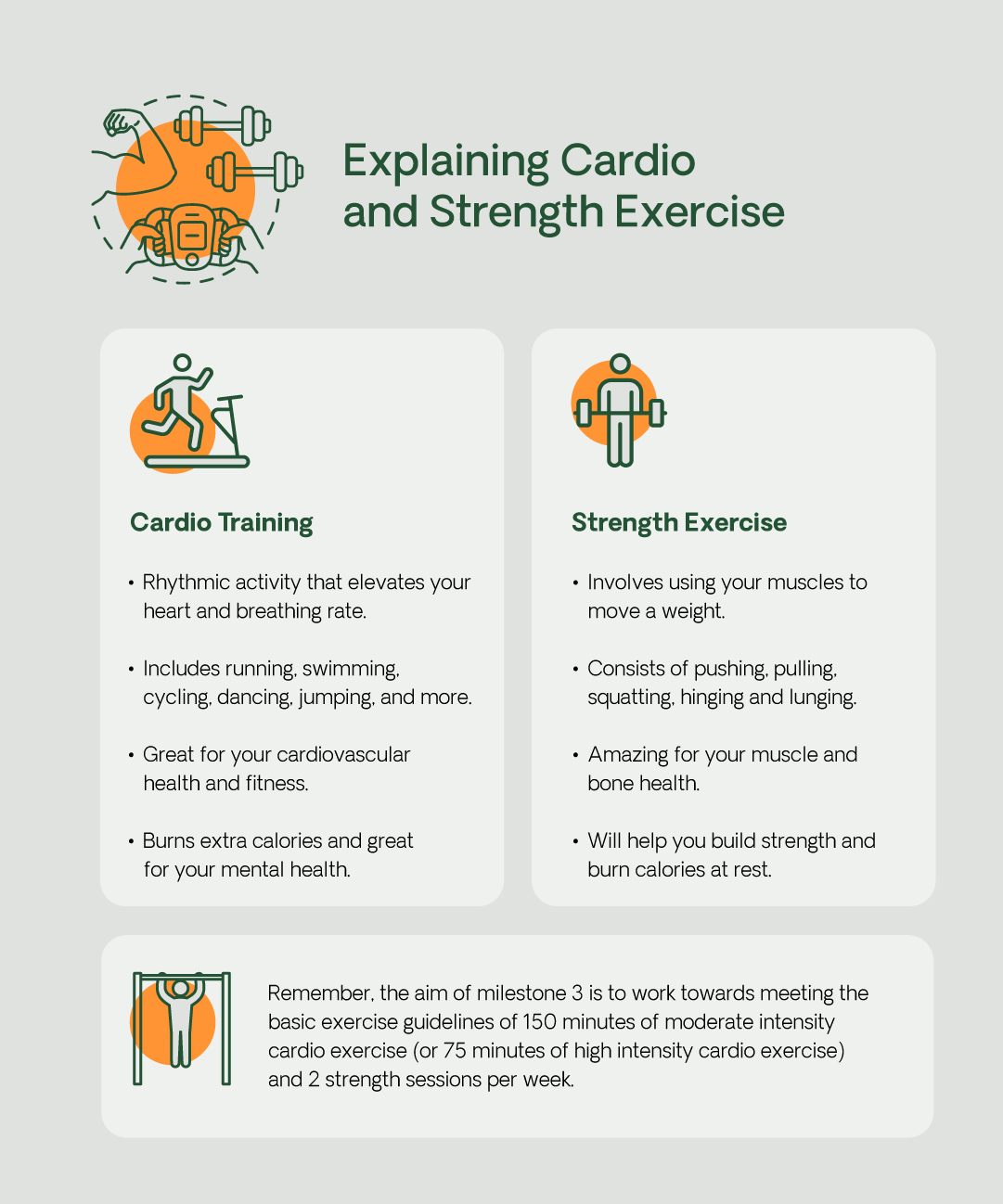
Cardio is short for ‘cardiovascular’, meaning cardio training improves your cardiovascular system (heart and blood vessels) – this makes it easy to remember why cardio is so beneficial! Cardio is simply any rhythmic activity which elevates your heart and breathing rate, such as swimming, running, dancing, cycling and much more. As you work towards your cardio goals, you will feel amazing mentally, physically and of course, it will help you lose weight.
Strength (resistance) exercise simply involves moving weight – this may be in the form of dumbbells, kettlebells, resistance bands, or your own bodyweight. There are fundamental movement patterns which lie at the heart of all strength exercises – pushing, pulling, squatting, hinging, lunging and carrying. As a result of progressing with these basic movement patterns over time, you can expect healthier bones and muscles, improved mental health, and better metabolism.
Over time, we will guide you through the process of progressive overload, which becomes more relevant as you acclimatise to exercise training in Milestone 3 and venture towards Milestone 4.
Relevance to Your Journey
You may be wondering why it is necessary to understand what cardio and strength training are. Firstly, while you may have a good idea already, there is always more to learn! The other key point is that you are at the stage in your journey where cardio and strength training become extremely important and are the two main parts of the basic exercise guidelines. As a brief reminder, for Milestone 3, your aim is to work towards 150 minutes of moderate intensity cardio per week (or 75 minutes of high intensity cardio) and 2 strength exercise sessions per week. Before taking your first steps towards this, we feel it is vital that you understand what these two key components are.
That is, it is helpful to understand not just what you are doing in relation to cardio and strength training, but why you are doing these things! By understanding the what, the how, and the why behind your exercise from Milestone 3 onwards, you will see the bigger picture and understand why exercise is the crucial next step in your renu journey. This also means that when times are tough, you will know the rationale behind everything you are doing, which should help you trust the process!
Now, it is time to go over the important details…
What is Cardio?
Cardio refers to the training of your cardiovascular system. This means that any sort of rhythmic activity that increases your heart rate to get your blood flowing is classed as cardio. You can probably think of many different examples of cardio given how loose the definition is. For example, cardio can include high-impact activities like running, playing sports, hopping, jumping and dancing, and low-impact activities like swimming, cycling and using the X-trainer. Essentially, the options are endless, which is great! This means your exercise journey will be filled with variety and you will be able to find cardio you love doing.
Cardio exercise also comes with some amazing health benefits. Of course, it burns a large number of calories and so is an essential tool for helping you achieve your weight loss goals. Beyond this, cardio is also amazing for your metabolic health in terms of blood sugar regulation and your mental health as it can be used to ease stress and anxiety.
You may (quite rightly) ask the following… ‘is all my movement in my day-to-day life not technically classed as cardio’. The answer is… it depends. When you are walking between places and climbing stairs then yes, this is cardio. However, Milestone 3 uses the term ‘exercise’ more so than ‘movement’ as we aim to create more structure in your exercise routine so as to ensure you meet the guidelines and work at the appropriate intensity.
What is Strength (Resistance) Exercise?
Strength training is sometimes referred to as resistance training, so don’t get confused, as these are used interchangeably. Strength training is simply using your muscles to move something that has weight – this may be resistance bands, dumbbells, or even your own body weight. Of course, the goal of strength training is to build muscle, make you stronger and ultimately make you more physically capable. Very broadly, we separate strength training into four primary movement patterns – you can push and pull with your upper body muscles, and you can perform hinge and knee bend movements (i.e. squats and lunges) with your lower body muscles, and your core is required to stabilise carry movements.. Your strength training will encompass these key movement patterns to ensure you stimulate all your muscles appropriately.
While strength training may not burn as many calories as cardio, it is extremely valuable for other reasons. For example, it will improve your muscle and bone strength to ensure you can do every-day physical tasks with ease and delay or even avoid age-related problems like sarcopenia and osteopenia/osteoporosis. Furthermore, having more muscle mass (energy factories) burning more calories increases your metabolism and like cardio, it is also great for your mental health.
A period of acclimatisation is vital for strength training, as you may have done very little in the past. While carrying shopping and doing gardening does stimulate your muscles, strength training is more demanding and considerably more structured. The concept of progressive overload is essential, whereby you perform exercises at an intensity that is not too hard, nor too easy. Then, over time, we progress the frequency, intensity, duration, or type of strength training you perform. The important thing is gradually working your way through the Milestone 3 content, beginning to understand your body and what it can handle, and following our guidance to progressively increase your strength and lean body mass!
A Key Takeaway
As has been mentioned previously, everyone is different and has varying physical capabilities. The key takeaway from this article is the start of Milestone 3 should be used as a time where you establish your capabilities with regards to cardio and strength training. As you acclimatise to cardio and strength exercise, you will have a clearer image of yourself and what you can handle and will know when it is time to progress your exercise as you reach Milestone 4!
Reference Links
247fitness.co. (2023). Benefits of Cardio and Strength Training. [online] Available at: https://247fitness.co/blog/benefits-of-combining-cardio-and-strength-training.