

Making changes to your habits and health behaviours is challenging, and maintaining progress can be even harder. However, there are proven ways to reduce relapses and get back on track when setbacks occur.
In this article, we’ll explore what a relapse is, how to learn from slip-ups and how to get back on track.
Whenever you are trying to make a change to your behaviours or mindset, it’s expected that at times you might relapse and fall off track. Although this is a common part of the journey, a lot of us will perceive these moments unfairly and view them as a failure.
Relapse prevention helps you to understand what chain of events led up to the setback taking place, which can help you to plan how to avoid similar situations in the future.
Relapse prevention can support you to adjust the views you have of a setback and improve your ability to cope with different challenges along the way.
What Is a Relapse?
A lapse is a brief slip-up, a temporary return to previously unhelpful behaviours.
For example, overeating at night because you didn’t make time to eat during the day.
A relapse is when you return to old habits or deviate from your goal for a longer period of time.
For example, stopping your habit of preparing healthy meals and snacks, and instead eating out at fast food restaurants for several days in a row.
Why Might I Relapse?
There are many reasons that can cause a setback or relapse, we’ve listed some of the common contributing factors to help you identify what might be getting in the way of your progress.
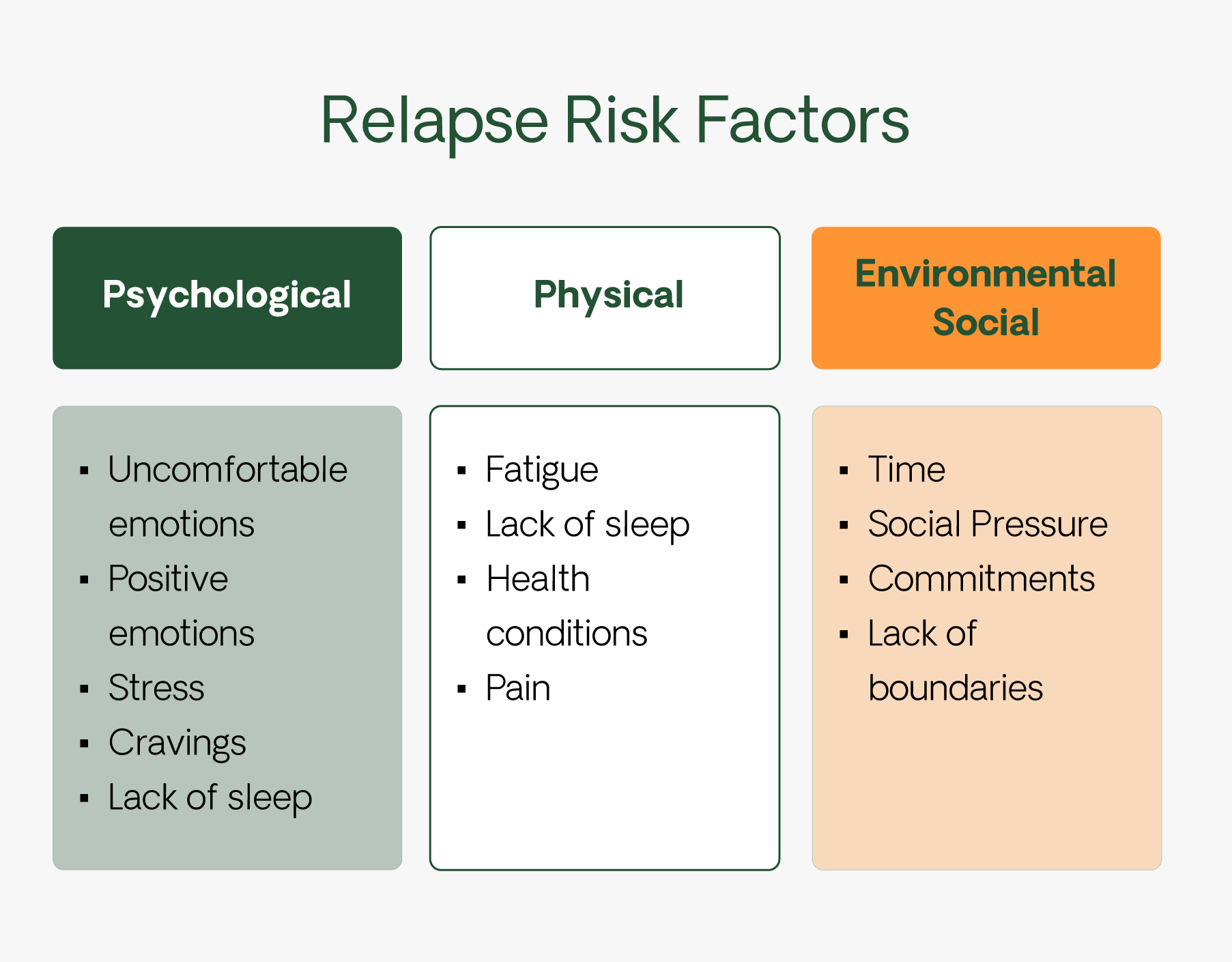
Physical Factors:
- Energy Levels | feeling tired and burnt out
- Physical Health | medical condition, pain
Psychological Factors:
- Uncomfortable Emotions | sadness, nervousness, frustration, anger, worry, grief, boredom, loneliness, guilt or shame
- Positive Emotions | joy, happiness, excitement
- Urges | a craving or desire that is hard to ignore
- Restrictions | avoiding certain food groups
Environmental & Social Factors:
- Time | work commitments, friends and family time, struggling to find time to prepare or monitor
- Social Environment | cooking for others, eating at work, eating at a restaurant, eating at a friend’s house, finding it difficult to say no
How Can I Prevent Relapses?
Setbacks and relapses are normal parts of progress, they don’t mean you have failed. They are usually caused by not having enough ways to cope, or not having the understanding of how to prepare for a triggering event.
Although setbacks along the way are common, there are many ways you can support yourself to avoid falling into a relapse. We’ve outlined some helpful ways here:
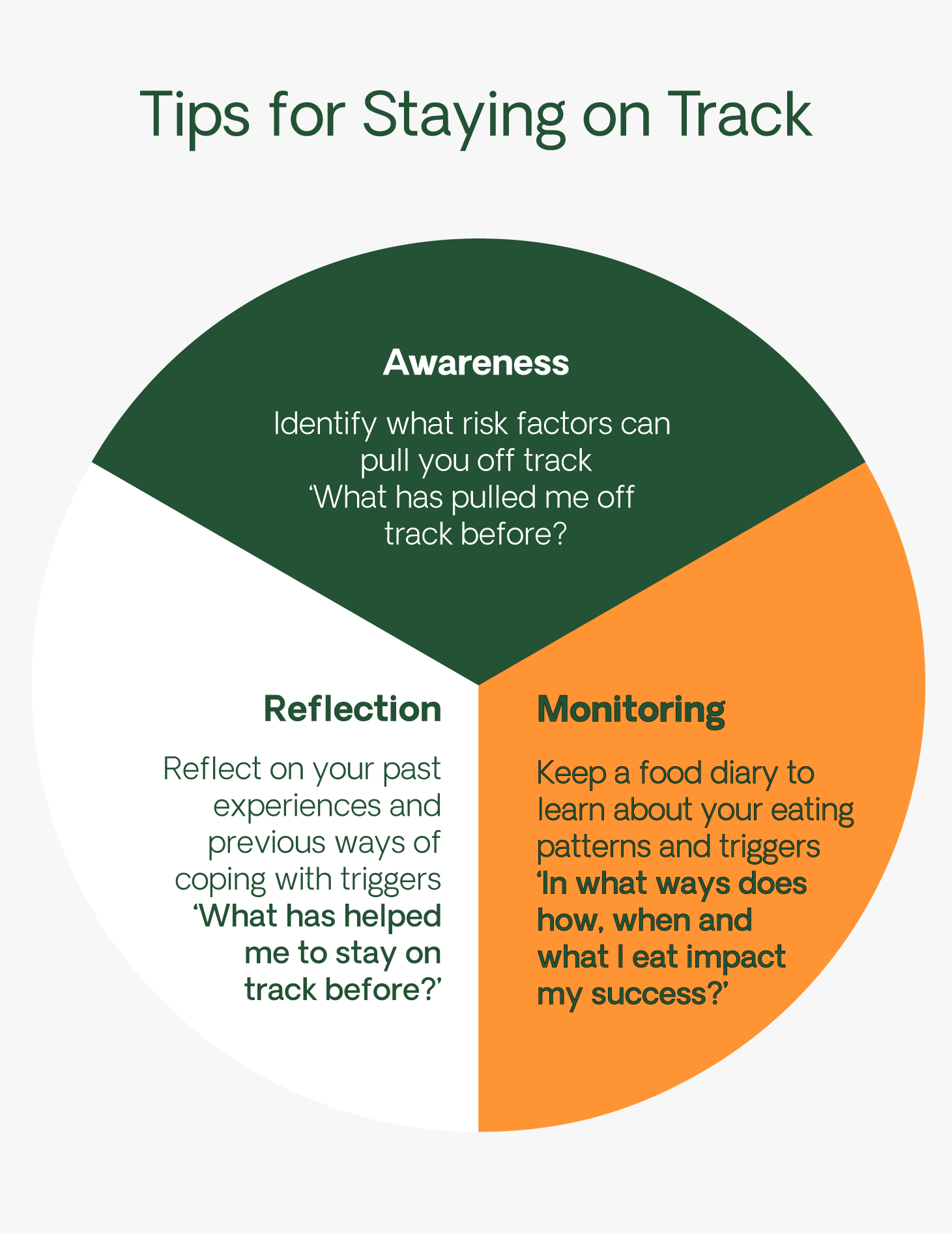
Awareness is an important initial step in being able to prevent and prepare for potential future setbacks and relapses.
Try to identify what psychological, physical and environmental / social factors can pull you off track. It can help to think back to previous experiences that can provide insight into what factors may have contributed.
Once you’ve identified what factors can pull you off track, get curious about how you can reduce the exposure to these triggers and increase your resources to cope with them
Monitoring is an ongoing process that can help you to build awareness and understand what helps you to achieve your goals and what gets in the way.
Try to keep a food diary to build your awareness of what, how and when you are eating. This can help you to recognise different patterns and factors that influence how able you are to maintain your progress.
Reflection is a process that helps you to understand your own thoughts and feelings, and how these can influence your behaviours.
Try to build a habit of reflecting on your internal experiences across different situations. What you think, feel and do are all connected, so understanding your own relationship between thoughts, emotions and behaviours can support you in making long-lasting changes and preparing for challenges.
Key Questions
- What are the most common factors that pull me off track?
- Are there any factors that I can limit my exposure to?
- How can I cope with my triggers? What tools or support can I engage with?
How Can I Get Back On Track After A Setback or Relapse?
Try not to make the same detour twice: When trying to build healthy habits, it’s been shown that missing one day doesn’t affect your ability to form a habit.
By remembering that everyone experiences days where they don’t do what they had planned, it becomes easier to manage your feelings about any lapses you experience. After you experience a lapse, try to not make the same decision a second time to help you stay on track.
Set a schedule: By creating a schedule you can increase your chances of getting back on track. If you rely on waiting till you feel motivated, or happy, more time than you planned could pass by without engaging in the habits you want to build.
Creating a schedule can help you to keep going with positive behaviour change no matter how you are feeling at the time.
Additionally, it can be useful to record your emotions before and after the activity as this can help you build the connection between the action and the generated positive emotion.
Seek Support: When we feel like we’ve failed we can experience feelings of embarrassment and shame, this can cause us to engage with unhelpful behaviours to try and cope with the uncomfortable feelings. Speaking with trusted friends and family can reduce this shame and help you to move forward.
Practice Self-Care: By practising self-care you can feel more able to cope when life throws challenges your way. Try to look after your mind and body in as many ways as you can to boost your ability to bounce back after a setback.
Progress involves many ups and downs, remember that a setback doesn’t equal failure but instead is a natural part of the journey.
Try to get curious about what factors contribute to your own setbacks and plan ahead for how you might cope with future challenges.
References
Lally, P., van Jaarsveld, C.H.M., Potts, H.W.W. and Wardle, J. (2009). How are habits formed: Modelling habit formation in the real world. European Journal of Social Psychology, [online] 40(6), pp.998–1009. doi:https://doi.org/10.1002/ejsp.674.